
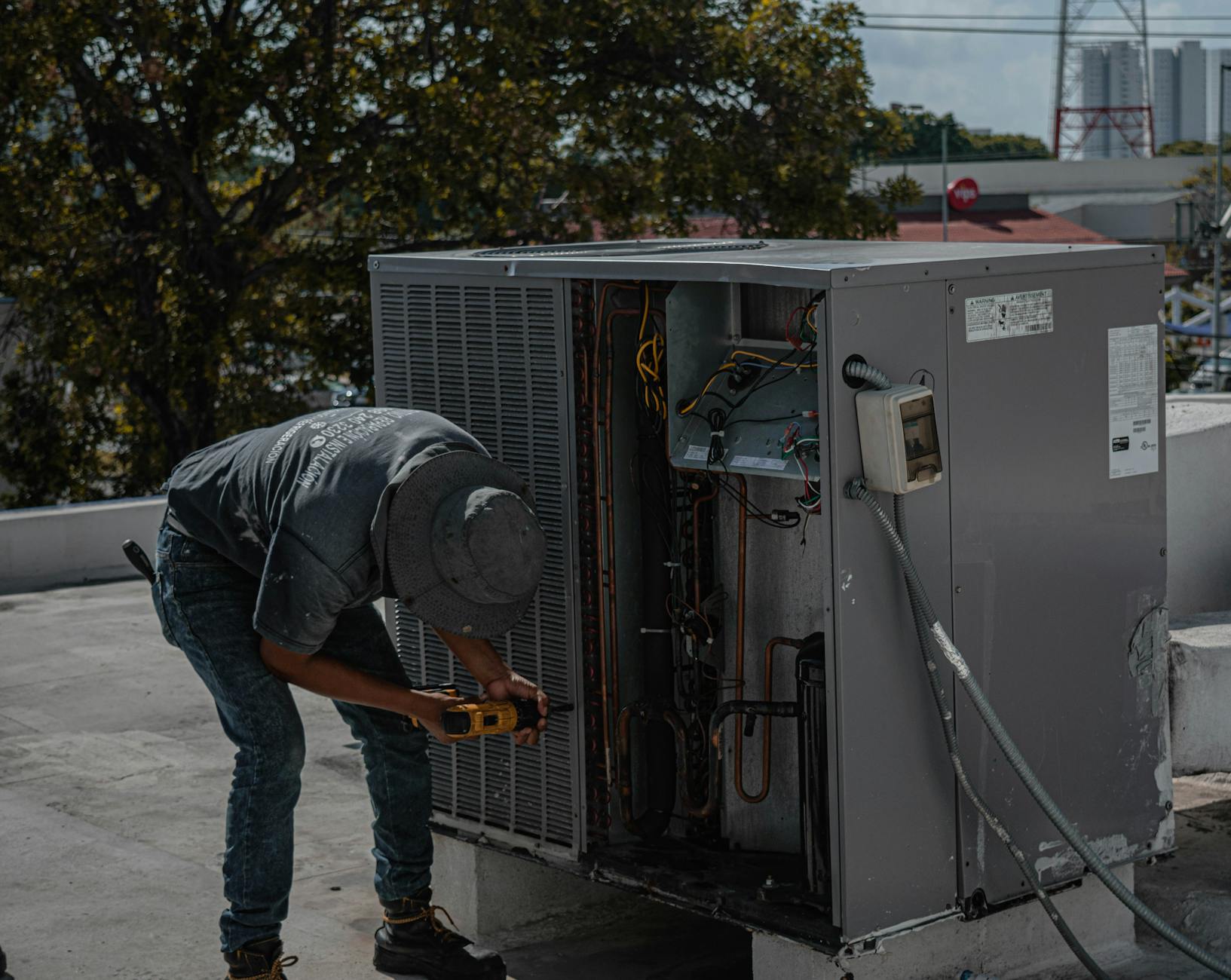
If your building has ductwork, it has fire dampers — and if those dampers haven't been drop tested in the last 12 months, you're not compliant. Here's what every facilities manager needs to know.
If your building has ductwork, it has fire dampers — and if those dampers haven't been drop tested in the last 12 months, you're not compliant. Here's what every facilities manager needs to know.
What is a fire damper drop test? Fire dampers sit inside your ventilation ductwork and are designed to seal shut the moment a fire breaks out, stopping smoke and flames spreading from one compartment of a building to another. A drop test checks that each damper actually does this when called on.
The test has two parts: a visual inspection to check for obstructions, dirt or damage, followed by the drop itself — releasing the damper from its open position to confirm it closes fully and seals the duct. Most dampers rely on a fusible link that melts at around 74°C, triggering the blade or curtain to fall.
Why it matters A damper that doesn't close in a real fire allows smoke and flame to travel through the ventilation system — straight past whatever fire compartmentation the rest of the building relies on. That's the difference between a contained incident and a building-wide emergency.
Beyond the safety case, there's a legal one. The Regulatory Reform (Fire Safety) Order 2005 puts the responsibility for working fire safety measures, dampers included, on the building's "responsible person." BS 9999:2017 sets out the technical detail: all dampers, regardless of type, tested at intervals not exceeding 12 months.
What the test involves **Preparation** — access confirmed (most dampers sit behind an inspection hatch), all dampers closed, obstructions and debris cleared.
**Visual check** — inspecting for damage, corrosion, misalignment or anything that would stop the blade closing fully.
**The drop test itself** — releasing the damper via its fusible link or release mechanism and confirming it closes and latches within the required time.
**Documentation** — date, location, who carried out the test, the result, and any remedial action taken. This record is what you'll be asked for in an audit or after an incident.
Common faults we find on site - Obstructions — dust, debris or building materials left in the duct blocking the blade - Misalignment — usually from poor original installation - Corrosion — particularly in older buildings or damp environments - Bent tracks or a twisted coil spring stopping the blade running freely - Rust on transit straps left in place after installation
Each of these is straightforward to fix once identified — the risk is only in not finding it until it's too late.
How often does testing need to happen? Annually, as a minimum, under BS 9999. Buildings in dustier or higher-pollution environments — commercial kitchens, industrial sites — may need more frequent checks, since debris build-up is the most common cause of failure.
What happens if you don't test Beyond the obvious safety risk, non-compliance carries legal and financial exposure for the responsible person named under the Fire Safety Order. Insurers will also ask for evidence of testing history following any fire-related claim.
How Calmbreeze approaches it We treat fire damper testing as an ongoing compliance programme, not a one-off job. For multi-site estates that means building a full asset register from scratch if one doesn't exist, surveying every damper, testing to BS 9999, and reporting back with photographic evidence and a clear remedial plan for anything that fails.
Our work with the University of Reading is a good example of what that looks like at scale: 560+ dampers surveyed and tested across 77 buildings on three campuses, delivered during term time with no disruption to staff or students, with live progress reporting throughout.
If your fire damper records are incomplete, overdue, or you've simply inherited a building without a clear history — get in touch for a survey.
📞 01895 919 333 · ✉️ Hello@calmbreeze.co.uk